Eye Color by Country: How Rare Is Yours?
An eye color can feel ordinary in one country and surprisingly rare in another. Worldwide, brown is by far the most common, while blue, green, gray, hazel, amber, red-looking, and violet-looking eyes vary a lot by region and family background.
Use this guide as a broad map. Country adds context, but it doesn’t tell the whole story by itself. Family background, ancestry, migration, local community, and mixed eye colors all matter too.
Why rarity changes by country
Eye color can feel more or less rare depending on the country or region. Brown eyes dominate globally, while lighter or mixed eye colors may feel more familiar in some parts of the world and much rarer in others. Country gives useful context, but it should be read as a broad clue, not a perfect measurement.
These country comparisons are broad guides, not a precise census of eye color in every country. Eye color data is often grouped differently from source to source, and many countries have mixed populations, migration history, and regional variation. Use country context as one clue, then compare your actual eye color in natural light.
Why country matters for eye color rarity
Most people don’t only wonder whether their eye color is rare worldwide. They also wonder whether it’s rare where they live, where they grew up, or where their family comes from.
That’s a useful question because rarity is partly about comparison. Blue eyes may feel familiar in one country and unusual in another. Green eyes may stand out globally but feel less surprising in some communities. Brown eyes may be the worldwide majority, but the exact shade can still vary beautifully from person to person.
Country helps you understand the setting around your eye color. It gives your result more context without pretending every country has one exact eye color pattern.
How to read an eye color by country map
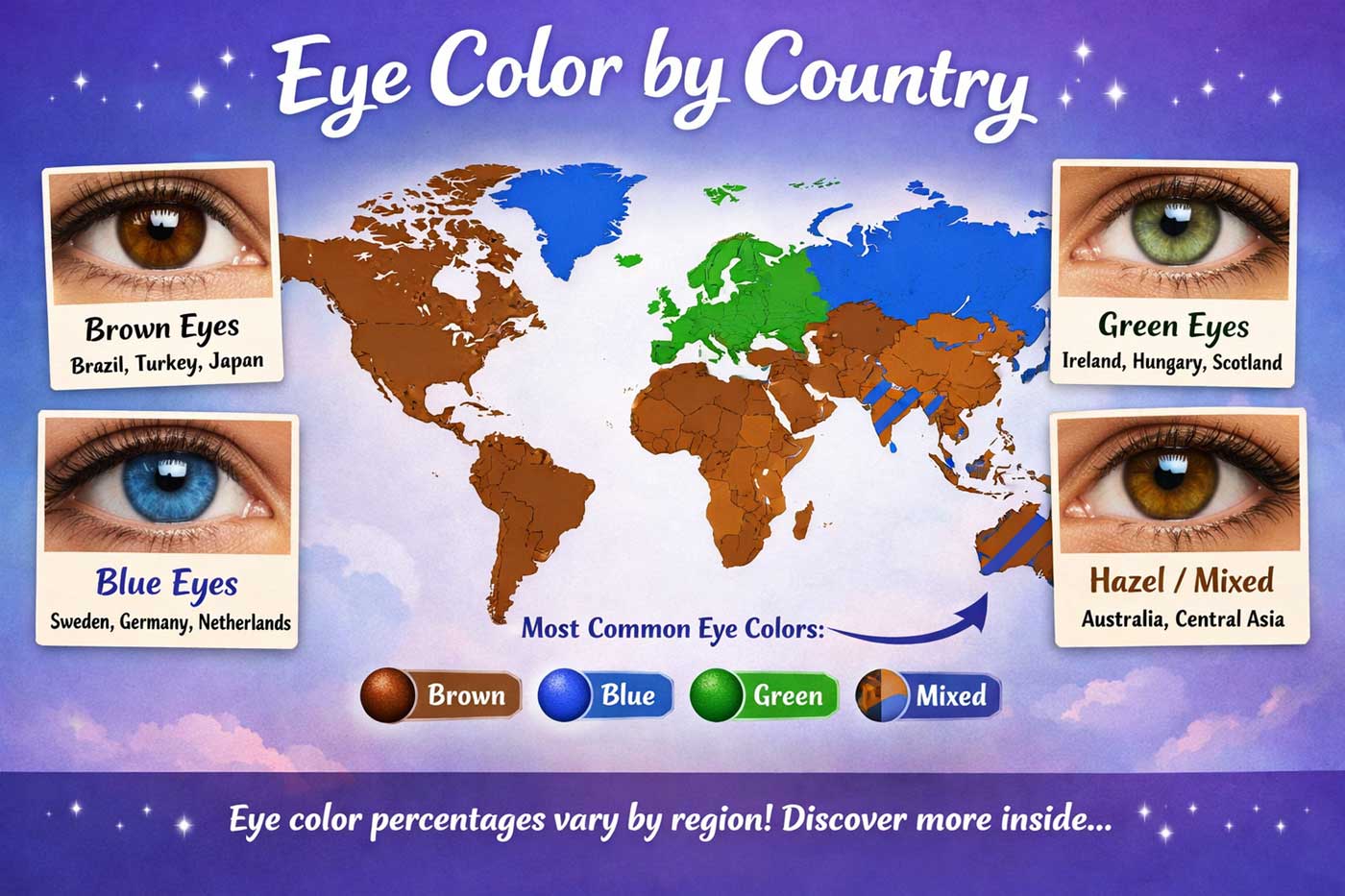
The easiest way to read an eye color map is in layers. First, start with the global picture. Brown is the most common eye color worldwide. Next, look at broad regions. Some lighter eye colors are more familiar in parts of Europe than they’re in many other parts of the world. Finally, think about your own local experience.
A color can be globally uncommon but still familiar where you live. The reverse can also happen. A color that feels rare in your town may be more common in another country or family background.
That’s why a country map is best treated as context, not a final answer. For your own eyes, the best next step is still natural light, the eye color chart, and the rarity checker.
How eye color varies by region
| Context | What it can tell you | What it can’t tell you |
|---|---|---|
| Country | Whether certain eye colors may feel more familiar or more unusual in a broad population. | Your exact genetic background or personal rarity. |
| Region | Whether lighter, darker, or mixed eye colors may be more common in a broad area. | The eye color pattern of every local community. |
| Family origin | Useful context for why your eye color may differ from the country where you live. | A guaranteed prediction of your eye color. |
| Natural-light check | The best way to choose your closest visible eye color. | Population rarity by itself. |
Broad regional eye color patterns
Brown eyes are common across much of the world, which is why they sit lower on the rarity scale. Dark brown and medium brown eyes are especially widespread globally.
Blue, green, gray, and blue-gray eyes are more strongly associated with some European populations and families with ancestry from those regions. That doesn’t mean those colors only appear there. They may just feel more familiar in some places than they do globally.
Hazel, amber, and light brown eyes can sit in a difficult middle area. They may feel common in one setting and strikingly unusual in another. Because they’re warm, mixed, and sometimes hard to separate, the hazel vs amber eyes guide is a good comparison.
Broad country and region snapshots
United States and Canada: Brown eyes are very common, but the populations are broad and mixed enough that many eye colors appear. Blue, green, hazel, gray, amber, and mixed eye colors can all show up, depending on family background.
Ireland, Scotland, Northern Europe, and parts of Eastern Europe: lighter eye colors such as blue, gray, and green may feel more familiar locally than they do worldwide.
Mediterranean and Middle Eastern regions: brown eyes are common, while hazel, amber, light brown, and golden-brown eyes may create more interest in the rarity conversation.
South Asia, East Asia, and much of Africa: dark brown and brown eyes are usually dominant, which can make blue, green, gray, amber, or hazel eyes feel especially unusual in everyday life.
Australia and New Zealand: eye color patterns can vary widely because of mixed ancestry and migration history. Brown, blue, hazel, and green may all feel familiar in different communities.
These are broad snapshots, not rigid rules. Every country contains variety, and every family has its own story.
Important limits to remember
Country of birth isn’t the same as ancestry, family history, or genetics. Someone may be born in one country, have family roots in another, and live in a community where eye color patterns feel different from the national average.
Self-reported eye color can also be inconsistent. One person may call their eyes hazel, while another might see green, amber, or light brown. Gray and blue are often confused too, especially in photos.
Use country context as one clue. Then check your eyes in natural light and compare the closest shades.
Country, ancestry, and lived experience
Two people from the same country can have very different experiences of eye color rarity. One person may grow up around many blue or green eyes. Another may rarely see them. Both experiences can be true.
Family background, ancestry, migration, and local community all shape what feels common or rare. That’s why the rarity checker treats country and family-origin details as gentle context rather than exact proof.
The most useful answer is usually a blend of global rarity, regional context, and what your eyes actually look like in natural light.
What to read next
If you want the global view, visit eye color percentages worldwide. If you want the rarest colors overall, read what is the rarest eye color?.
If you’re trying to decide between two close colors, start with the compare eye colors hub. Green vs hazel, gray vs blue, hazel vs amber, and amber vs brown are good starting points.
For a personal estimate, use the eye color rarity checker and add your country or family-origin region if you want the result to feel more specific.
Sources and notes
Country and regional comparisons are broad estimates, not a precise census or medical advice.